
An actor trick to help you hear a play
Answering: What’s scansion and how does it help you understand Shakespeare?
Estimated read time:
TLDR:
School gave you a hammer when you needed a magnifying glass. Roen gives you their scansion cheat codes so you can hear what Shakespeare's saying through the rhythm.
Iambic pentameter & scansion
I said last week that Shakespeare and other verse playwrights deliberately chose the words they did to guide you through the story just by hearing it.
A major tool in their toolbox: iambic pentameter.
Now, if you've been burned by Shakespeare in your middle or high school classroom, you're not alone. And you're not bad at Shakespeare.
You just weren't given the tools that the text is designed for.
You were given a hammer when you needed scales, a screwdriver set, tweezers and a magnifying glass.
So here's a brief intro to scansion, iambic pentameter, and how they can help you hear your next (or first) Shakespeare play.
Shakespeare uses and breaks iambic pentameter to tell you what's important, and what the character is feeling.
Scansion is how actors find those hints and share them with the audience.
On paper, it's a technique for notating the rhythm of poetry by assigning a “/” over stressed (or emphasized) syllables and a “U” over unstressed syllables.
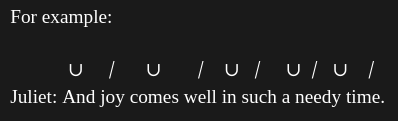
Juliet’s line has five iambs: pairs of an unstressed syllable followed by a stressed syllable. This is a regular line of iambic pentameter.
For example, the word “unstressed” would have a / over the first syllable, un, and a U over the second syllable, stressed.
!!!Before you notate!!!
Read it aloud. Let the words flow naturally!
The rhythm will most likely support how the words are typically pronounced.
When a natural pronunciation interrupts the iambic pentameter, there’s a reason. Shakespeare uses other rhythms to call attention to a particular word or thought, or signal a character's turbulent emotions.
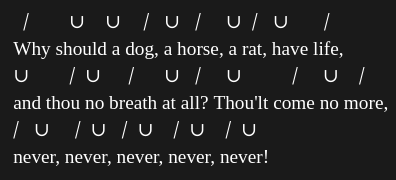
Lear's irregular scansion shows his rising despair and grief at his daughter Cordelia's death, ending with five trochees (stressed then unstressed: the opposite of an iamb) in a row.
Lear's irregular scansion shows his rising despair and grief at his daughter Cordelia's death, ending with five trochees (stressed then unstressed: the opposite of an iamb) in a row.
If a word could be pronounced a couple different ways (like hour, which could be one syllable or two), it's up to you to decide how you want to speak it based on the character's emotions.
If you see a word ending in -ed with an accent mark over the e, that tells you that the -ed ending is pronounced like the name Ed, giving the word an extra syllable.
For example, naméd is pronounced "NAME-ed" instead of the single syllable "named."
Conversely, if you see a word that should end in -ed with an -'d instead, the end syllable is removed to shorten the word.
We'll talk about that more next week.
My Invitation For You
RGS is starting to plan for our first outdoor shows (grant funding pending)! Subscriber revenue helps us produce them consistently.
Plus, you get on demand access to every show we do, so you can keep hearing plays even when the weather's bad!
