
Counting syllables & elision
Answering: How do I start scansion?
Estimated read time: 10 minutes
TLDR: Roen continues their scansion cheat codes so you can hear what Shakespeare's saying through the rhythm.
I said last week that the syllables of words might be fluid. Like, if a word can be pronounced a couple different ways (like hour, which could be one syllable or two), it's up to you to decide how you want to speak it based on the character's emotions.
If you see a word ending in -ed with an accent mark over the e, that tells you that the -ed ending is pronounced like the name Ed, giving the word an extra syllable.
For example, naméd is pronounced "NAME-ed" instead of the single syllable "named."
But if you see a word that should end in -ed with an -'d instead, the end syllable is removed to shorten the word.
That removing a syllable is called elision. Shakespeare often uses it to keep a line from going over ten syllables.
But why is the syllable count so important?
Because iambic pentameter has a pre-set, expected rhythm, any change in that rhythm is a clue into the character's emotional state.
If there are fewer than ten syllables, one of two things might be happening.
One: there's a pause. Up to your interpretation where the pause happens in relation to your words.
Two: it's a shared line. A shared line is, well, a line of iambic pentameter that's shared between speakers (usually just two).
Take a look below at the rapid-fire back-and-forth between Lady Macbeth and Macbeth right after killing King Duncan (source: Folger Shakespeare Library).
Four sentences make up a single shared line.
How do I know it's rapid-fire?
Because the lines are shared.
Shared lines should be spoken as if it's a single line; faster than your normal dialogue response times.
From "Did not you speak?" to "As I descended," eleven syllables are spoken.
The shared lines tell me that the back and forth is frantic. Macbeth and Lady Macbeth are on pure adrenaline, having just murdered their king in their own house while strange noises plagued them. They're terrified of being caught, in full crisis mode trying to decipher what they heard.
The fact that there's eleven syllables is also interesting. Perhaps Macbeth's words are tumbling over each other, as if he doesn't have enough time to get them all out. The extra syllable adds pressure.
I learned a fun way to track the "pulse" of a Shakespeare speech from Stone Soup Shakespeare, connecting dots to make a "heart monitor" readout of the speech in the margins. Here's how it works:
Syllable heart monitor
1. Arrange a number line above the left margin of your text.
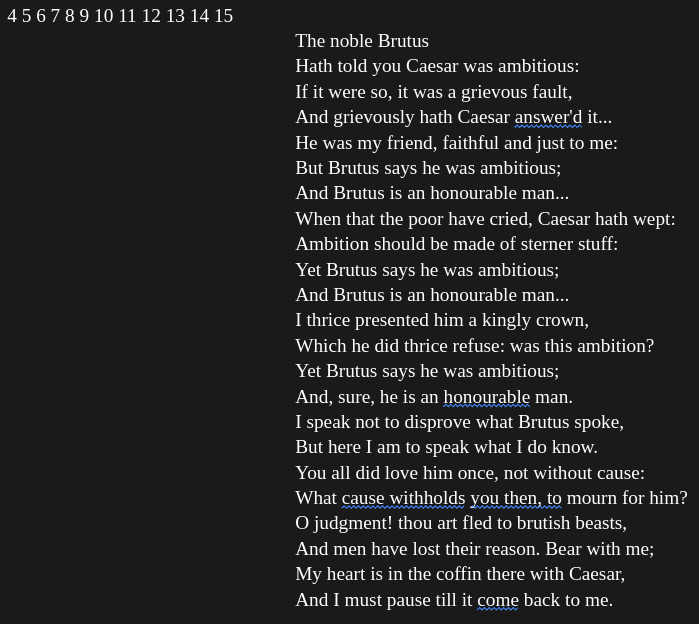
2. Mark a dot at each line’s number of syllables (like plotting numbers on a graph; the dot should be horizontally in line with the line of text, and vertically in line with the correct number on the number line. See the example below.)
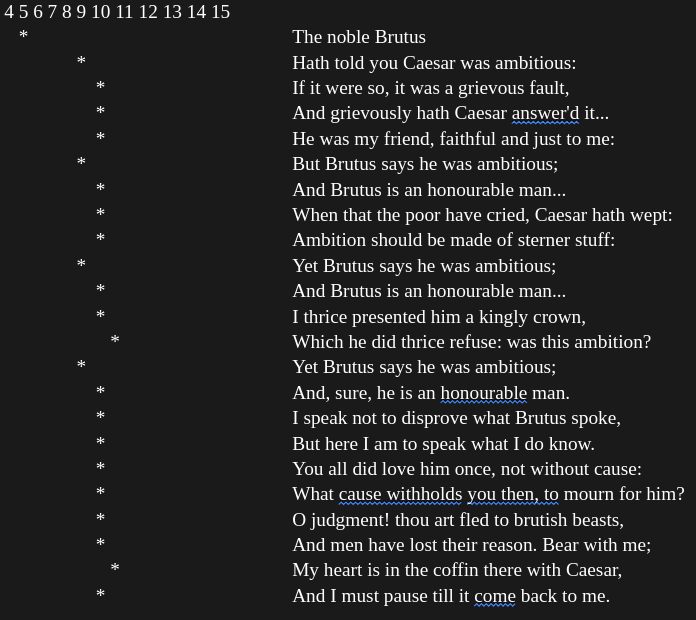
3. Connect the dots with straight lines.
4. Turn your paper sideways so that the smaller numbers are on the bottom and the bigger numbers are on the top. The connected dots should look like a heartbeat monitor. Dots representing lines with fewer syllables should be lower on the page. Dots on lines with more syllables should be higher on the page.
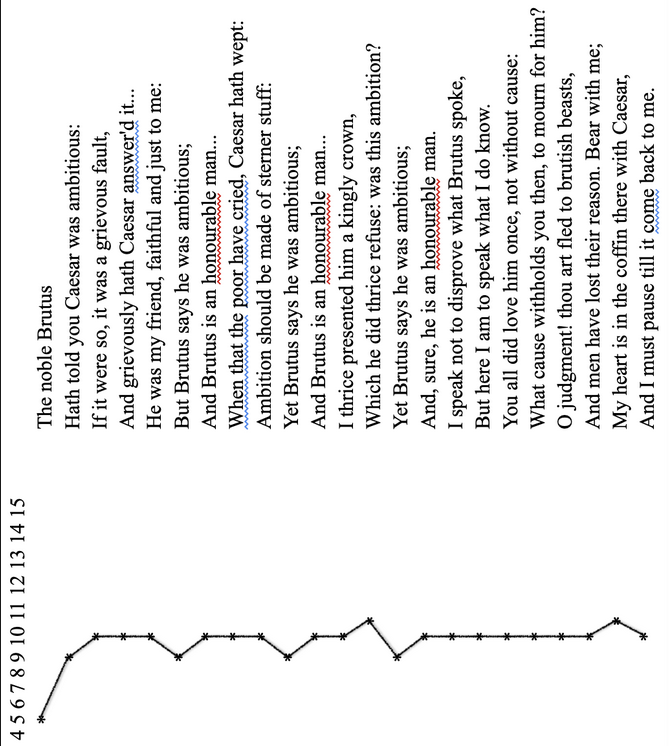
This “heart monitor” shows the emotional “pulse” of the speech. Notice where the average sits:
Does the speech hang around a perfect 10, implying a measured, balanced, or in-control emotional state?
Does it center around less than 10, implying exhaustion, pauses for thought/effect, or a slower pace?
Does it center around more than 10, implying a rush or frantic feeling?
Does it fluctuate gradually? Suddenly jump? These are two very different kinds of transitions between energy levels, and those transitions communicate two different emotional states.
Note: some supernatural characters in Shakespeare use a different rhythm, and their speeches may not follow iambic pentameter. This includes Puck, Titania, and Oberon from Midsummer Night’s Dream and the Weird Sisters from Macbeth.
What if there are fewer than 10 syllables in a verse line?
Less than 10 syllables means there is a pause to make up the missing syllables. This could mean:
pausing to collect thoughts
despair
pausing to make an impact with the character’s audience (another character or the actual audience)
And more. Look at the context of the scene and play to see what makes sense for your character in this moment.
More than 10 syllables in a verse line?
More than 10 syllables implies a rush; the character is cramming too many syllables into a single line. This could mean:
panic
a character feels like they don’t have enough time
rush of emotion
scheming, brain running faster than the mouth can keep up
And more. Again, look at the context of the scene and play to see what makes sense for your character in that moment.
My Invitation For You
RGS is starting to plan for our first outdoor shows (grant funding pending)! Subscriber revenue helps us produce them consistently.
Plus, you get on demand access to every show we do, so you can keep hearing plays even when the weather's bad!
