
Why do you prefer outdoor theatre?
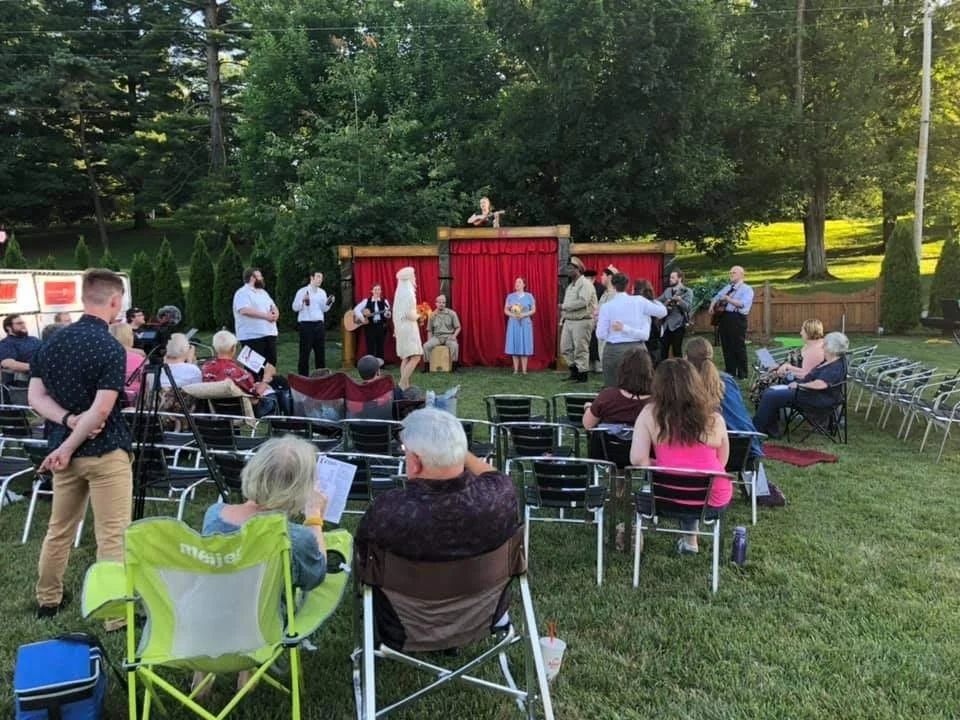
An outdoor performance of Othello, Hoosier Shakespeare Festival, 2019
Answering: Why do you prefer outdoor theatre?
Estimated reading time: 10 minutes
TLDR
Outdoor theatre lowers the financial load on small and emerging theatre companies. It can be more accessible to the public than indoor shows, especially if the production is free or pay-what-you-can. Outdoor theatre has its challenges, but opens the door for unique, memorable moments. And the human-focused nature of outdoor theatre allows for deeper human connection between actor and audience.
Table of contents
The Budget Practicality Of Outdoor Theatre
Challenges And Resulting Opportunities In Outdoor Theatre
Accessibility In Outdoor Theatre
Human Connection In Outdoor Theatre
Tips For Attending Outdoor Theatre
The Budget Practicality Of Outdoor Theatre
When the sun is your lighting and a few trees are your set, you’ve just cut your production budget in half. Not to mention simplifying your storage needs, reducing the time it takes to build the technical elements of the show, and simplifying tech week, where the technical elements of props, costumes, lighting, sound, and set all come together. Additionally, you don’t have the overhead of a brick and mortar venue when you have permission to pop up in a public space.
The lower equipment budget lowers the financial barrier to entry for small and emerging theatre companies.
It also allows companies to focus their finances on paying the people that make the show happen.
This is part of Roguish Goblin Stories’s mission: paying artists $20/hour or better because we emphasize the human over the spectacle in every production budget.
Challenges And Resulting Opportunities In Outdoor Theatre
Outdoor theatre comes with its challenges. Whether it’s pausing a monologue to let a loud vehicle pass, trying not to flinch when the fifth mosquito lands on your face while you’re playing dead after a battle, keeping props from blowing away backstage, staying hydrated in the summer heat, or chasing the odd racoon off the stage, outdoor theatre will keep you guessing.
Challenges are where theatre people shine.
We are adept at adapting: grab the nearest rock to paperweight the scrolls on the prop table. Make a moment out of waiting for the motorcycle to go by.
We are built for teamwork. Cast mates pass water around between scenes, even sneaking it onstage when it makes sense for the scene. Human well-being is more important than a “perfect” show.
I’d argue that live theatre is so enduring because it has unpolished moments. The audience gets a special “I was there when” story that nobody else will ever have. Flubs and bugs and passing cars are part of the story experience: one that reminds us it’s okay to be messy, because messy is human.
Accessibility In Outdoor Theatre
When the show is in a public park, passerby can find it much more easily than if the show was inside a closed theatre building.
As a traveling actor with over seven years of Shakespeare experience, I can confirm. I’ve seen countless heads turn from a nearby sidewalk when we start fight call: people unexpectedly sword fighting in slow motion is an excellent attention-getter!
My favorite instance comes from three kids who were riding their bikes around a small town, trying to stay entertained during the summer break. We’d set up our stage (eight posts with some curtains drawn between) in the middle of a blacktop parking lot. We’d started fight call. The swords clanged.
The kids turned. Walked over. Asked what we were doing.
We told them we were doing a play, and it was free. They were welcome to stay, or come back when the preshow music started in about a half hour.
They nodded, having never seen Shakespeare performed, and wandered off. A couple of us assumed that, given our estimates of their age, they might’ve already been introduced to Shakespeare via a middle school English class: a common turn-off for folks who might resonate with the Bard’s stories.
But, a half hour later, the three kids showed back up. They sat on the hot blacktop since they didn’t have camp chairs to bring with them.
A retired gentleman saw them shifting on the hot pavement.
During our pre-show VIP seat fundraiser, where we auctioned off the front two seats
Sound equipment is crucial to helping your audience hear you over environmental background sounds.
If your show runs past sunset, a couple light trees or even LED work lights from the hardware store will keep your actors visible.
Human Connection In Outdoor Theatre
As a performer, my memories of human connection during outdoor theatre far outstrip my memories of human moments during indoor theatre.
Part of this is due to the unpredictable variables involved in passing traffic, animals, etc.
But a lot of it has to do with the universal lighting.
When the sun’s your light source, the audience isn’t hidden away in the dark. I personally prefer this structure, because it allows me to connect more directly with you in character. It makes the show more collaborative, more experiential: you’re part of the story, not passively watching from beyond the fourth wall.
And it has a visceral impact on audience members, too.
After performances, I hang out in the lobby to thank audience members for supporting the show. Most of my conversations after indoor shows go something like this:
“Oh you were wonderful!”
“Thanks so much!”
My conversations after outdoor shows look very different:
“Thanks for interacting with my kid in that one scene. We’ve been working on being okay with saying ‘I don’t know,’ and this is the first time I’ve seen them say it without having a meltdown.”
“Because I see you, I know I’m gonna be okay.”
“I’ve never seen someone like me onstage.”
And more.
Tips For Attending Outdoor Theatre
Many outdoor theatres are seasonal pop-ups rather than permanent structures. So bring your own chair or blanket to sit on.
Sunscreen and bug spray are highly recommended. Sun hats, fans, or parasols are great for warding off the summer heat. Just make sure you’re not blocking the view of the audience member behind you.
Food and drinks: depending on the location, you might be able to bring your own picnic to enjoy during the show! If you forget, you likely still have options. Look for simple concessions like bottled drinks and single-serve chips at the front of house table. If the theatre doesn’t provide their own concessions, they might have placed their show strategically near a locally-owned coffee shop or restaurant. If you’re unfamiliar with the area, it never hurts to ask an usher or fellow audience member. Worst case scenario, they don’t know, but you’ve made a new friend!
Interacting with the cast: outdoor theatre means performers can see you quite clearly. And we’re often trained to use direct address: where an actor will deliver their lines to you, an audience member, as if you’re a fellow character in the show. For my introverts: don’t panic. It’s okay if you don’t know how to respond. We’re not looking for a witty, on-the-spot quip. We’re just looking for someone who’s engaged and present with us. So if you’re on their phone, we’ll notice. Conversely, if you’re paying attention, our actor hearts will be thrilled! Even if you don’t verbally respond.
FAQs
What should I bring to an outdoor show as an audience member?
Weather appropriate clothes, chairs or blankets to sit on, sunscreen, bug spray, water, fans, raincoats, and anything else you need to take care of yourself in the elements.
Is outdoor theatre more accessible than indoor theatre?
In some ways. Outdoor shows are often lower-budget, making them easier to produce for small emerging companies. They’re easy to find in publicly accessible locations, even if you never saw a show poster advertising the event. Many (but not all) outdoor shows are free or sliding scale, making the tickets more financially accessible. Indoor venues can control ADA accessibility in their construction, whereas outdoor spaces may or may not have basics like wheelchair ramps.
Want to learn more? Follow our newsletter to be the first to know about our next outdoor show!
